Specialty Services · Backflow
Backflow Prevention and Testing
Got a test notice from your water provider, or a preventer that is dripping, cracked or failed its last test? We test backflow assemblies, repair or rebuild them when they fail and install new ones where protection is needed.
- Upfront quote before work starts
- Test readings for your report
- Repairs & rebuilds
- Residential & commercial
Backflow Service Line
Backflow test due?
(888) 206-2089
Tap to call- Irrigation and sprinkler assemblies
- RPZ and double check valves
- Fire and boiler line protection
What Backflow Prevention and Testing Covers
Water is supposed to flow one way: from the public main, through your meter and into your home or business. Backflow is what happens when it reverses. If pressure in the main drops suddenly, from a main break or firefighters drawing heavily on hydrants, water can be siphoned backward out of a sprinkler system, boiler, pool fill line or commercial process. If a pump or boiler on your side pushes harder than the supply, it can force water backward too.
A backflow preventer is the one-way gate that stops that from happening. Depending on the hazard, it may be a pressure vacuum breaker on a lawn irrigation line, a double check valve assembly on a building's water service, or a reduced pressure zone (RPZ) assembly on a high-hazard connection. Each one relies on springs, check valves and rubber parts that wear, foul with debris or crack in a freeze, which is why water providers commonly require them to be tested.
Backflow prevention and testing from Green Plumbing covers the whole job. We test assemblies with a calibrated gauge and record the readings for your report. We rebuild or replace assemblies that fail, repair freeze damage and install new preventers where your property needs protection.
If your water suddenly looks, smells or tastes unusual, stop drinking it, use bottled water and contact your water provider right away. Never remove or bypass a backflow preventer. If one is leaking, shut off the line it serves and call us.
Signs Your Backflow Assembly Needs Attention
- You received a test notice from your water provider
- The relief valve drips or dumps water steadily
- Water sprays from the body, bonnet or test cocks
- The assembly cracked or leaked after a freeze
- Bolts, fittings or test cocks are badly corroded
- The assembly failed its last test
- You are adding irrigation, a boiler, a pool or new equipment
What we handle
Backflow Services
Annual Testing
We test each check and relief valve with a calibrated gauge and give you the readings for your water provider.
Failed-Test Repairs
Debris, worn checks and weak springs are cleaned or replaced, and the assembly is retested.
Freeze Damage
Cracked bodies, bonnets and test cocks are repaired or the assembly is replaced, plus advice on winter protection.
RPZ Service
Dripping or discharging reduced pressure zone assemblies are tested, cleaned and rebuilt.
New Installations
The right assembly for the hazard, installed at the proper height and tested on completion.
Commercial and Fire Lines
Restaurants, offices, multi-family buildings and fire sprinkler assemblies, tested in as few visits as possible.
Our Backflow Prevention and Testing Process
- Inspect the assembly. We check the type, size, condition and installation, and record the make, model and serial number.
- Run the test. A calibrated gauge connected to the test cocks confirms each check holds and the relief valve opens when it should.
- Explain the results. If the assembly passes, you get the readings. If it fails, we tell you why.
- Give an upfront quote. You know the price of any rebuild or replacement before we begin.
- Repair and retest. We replace worn parts or the assembly and retest it.
- Restore service. We turn the water back on, check for leaks and leave the area clean.
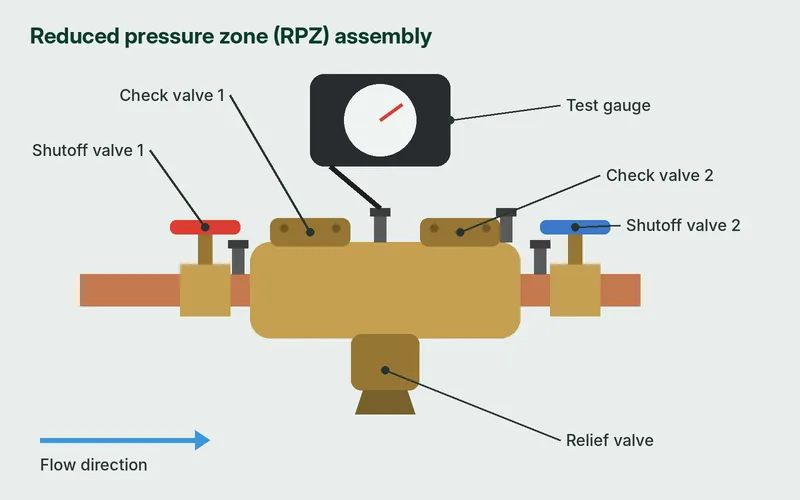
How an RPZ works
Two check valves stop reverse flow. If either one leaks, the relief valve between them opens and discharges water, so contaminated water can't reach the supply.
Choosing the Right Backflow Preventer
- Pressure vacuum breakers are common on lawn irrigation, where the risk is back-siphonage.
- Double check valve assemblies protect lower-hazard connections, such as many building water services and fire lines.
- Reduced pressure zone (RPZ) assemblies protect high-hazard connections, such as chemical, medical, car wash and many commercial uses.
- Hose bib vacuum breakers stop hoses left in buckets, pools or sprayers from siphoning back.
Your water provider may specify which type is required for your connection. We install the assembly that meets the requirement and fits the space.
Residential and Commercial Backflow Testing
For homeowners, backflow work usually means the irrigation assembly near the meter or beside the house, plus hose bib protection and boiler feed lines. We test, repair and winterize these assemblies and explain what your notice requires.
Businesses often have several assemblies on domestic, irrigation, fire and process lines. Restaurants, medical and dental offices, car washes, schools and multi-family buildings commonly fall under yearly testing. We test them together whenever possible and schedule work to limit disruption.
Honest, Upfront Pricing
We don't publish one-size-fits-all prices because backflow work depends on the assembly, its size, access and what it needs. We inspect first, explain what we found and give you a clear quote before any repair or installation begins.
How to Keep Your Backflow Assembly Working
- Test on the schedule your water provider sets, and keep the reports.
- Drain outdoor assemblies before the first hard freeze.
- Use an insulated cover or enclosure that still allows test access.
- Keep plants, mulch and soil clear of the test cocks.
- Have the assembly checked after a freeze, storm or main break.
- Never remove or bypass the preventer.
For more tips, visit the Green Plumbing blog or our plumbing FAQ.
Service areas
Find Backflow Prevention and Testing in Your City
Choose your city for local backflow prevention and testing information, service-area details and answers to common questions.
Alaska
Arizona
Arkansas
California
Colorado
Delaware
Florida
Georgia
Hawaii
Illinois
Indiana
Kentucky
Louisiana
Maine
Massachusetts
Michigan
Minnesota
Montana
Nebraska
New Jersey
New York
North Carolina
Ohio
Oregon
Pennsylvania
Rhode Island
Tennessee
Texas
Washington
West Virginia
Wisconsin
FAQ
Backflow Prevention and Testing Questions
How much does backflow testing cost?
It depends on the type and size of the assembly, how many assemblies you have, how easy they are to reach and whether repairs are needed. A single home irrigation assembly is a smaller job than several commercial or fire line assemblies. We confirm the details and give you an upfront quote before any work begins. Call (888) 206-2089 to book.
How often does a backflow preventer need to be tested?
Your water provider sets the schedule. Many require a test once a year, and often after an assembly is installed, repaired or relocated. The notice you receive lists the deadline, and we can test the assembly and give you the results your provider needs.
What is backflow?
Backflow is water flowing the wrong way, from a property back into the drinking water supply. It happens through back-siphonage, when supply pressure drops during a main break or heavy hydrant use, or backpressure, when a pump, boiler or elevated tank pushes water backward. A backflow preventer stops both.
What happens if my backflow preventer fails?
A failed test means the assembly isn't fully protecting your water. Most failures come from debris, worn rubber checks or weak springs. We can usually rebuild the assembly and retest it on the same visit, or replace it if a rebuild isn't practical.
What is the difference between an RPZ and a double check?
A double check valve assembly has two independent check valves and is used for lower-hazard connections. A reduced pressure zone (RPZ) assembly adds a relief valve between the checks that discharges water if either check fails, so it is used for higher-hazard connections such as chemical, medical and many commercial uses.
Why is my backflow preventer leaking or dripping?
A brief discharge from an RPZ relief valve during a pressure change can be normal. Steady dripping usually means debris or a worn part. A spray or crack after cold weather points to freeze damage. If the service line itself is leaking, our water line repair team can help.
Can you install a new backflow preventer?
Yes. We install the right assembly type for the hazard, at the correct height and orientation, and test it after installation. If corroded piping around it needs work, we handle pipe repair at the same time.
Does a backflow preventer improve my water quality?
It protects the public supply from water flowing backward, but it doesn't filter or treat the water coming into your home. For taste, odor, hardness or contaminant concerns, see our water filtration and treatment service, and if a burst line needs attention right now, our emergency plumbers are available day or night.
What Customers Say About Our Backflow Prevention & Testing Service
Had a great experience with Green Plumbing? We'd be grateful if you shared it. Your review helps neighbors find a plumber they can trust when it matters most.
Call (888) 206-2089 any time — and ask your technician how to leave a review.
Need a plumber right now?
Talk to a real person at Green Plumbing, day or night. We'll give you clear next steps on the phone and send a licensed plumber your way.